
Most businesses collect customer data every day and never use it. Email addresses pile up in Mailchimp. Purchase histories sit in Shopify or Square. Google Analytics tracks visitor behavior that nobody reviews. The data is there. The problem is nobody has organized it into something useful.
That's what customer segmentation strategies fix. Segmentation takes your existing customer data and groups buyers by shared traits so you can send the right message to the right people at the right time. It's one of the most reliable ways to improve response rates, reduce wasted ad spend, and increase repeat purchases. According to Campaign Monitor, segmented email campaigns generate up to 760% more revenue than unsegmented sends. That number comes from email, but the principle applies everywhere: the more relevant your message, the better it performs. This works for both B2C and B2B brands.
At Creative Options Marketing, we've helped businesses in Denver, across Colorado, and throughout the U.S. build segmentation strategies that work with the data and tools they already have. This guide covers how to do the same for your business, step by step.
- Customer segmentation strategies group your buyers by shared traits so you can send the right message to the right people
- Start with 3-5 segments based on data you already have, not 30 segments from an expensive platform
- B2B segmentation uses firmographic and behavioral data, not demographics alone
- The best segmentation tool for most businesses is the CRM or email platform they're already paying for
- Segmentation without measurement is guessing. Tie every segment to a KPI
01 - DefinitionWhat Is Customer Segmentation?
Customer segmentation is the process of dividing your customer base into groups that share specific characteristics, so you can tailor your marketing, sales, and service to each group's actual needs.
That sounds simple. In practice, most businesses skip it because the advice they find online assumes they have a data science team and a six-figure marketing technology budget. They don't.
If you have a dedicated data science team and a fully implemented customer data platform, much of this will feel basic. This guide is written for businesses that need segmentation to work before it's perfect.
For most businesses, segmentation isn't about perfect data. It's about usable signals. You don't need a customer data platform to get started. You need a clear look at who's buying from you, how often, and why.
Customer segmentation is related to market segmentation strategies, but they're not the same thing. Market segmentation looks at an entire market to identify opportunities. Customer segmentation focuses on the people who already interact with your business, the ones who've bought, browsed, signed up, or inquired. That's a more practical starting point because you already have their data.
If you're a Cherry Creek retailer, a SaaS company in the Denver Tech Center, or a service business anywhere in Colorado, you already have enough data-driven marketing information to build your first segments today.
02 - Types & ExamplesThe Four Core Types of Customer Segmentation (With Examples)
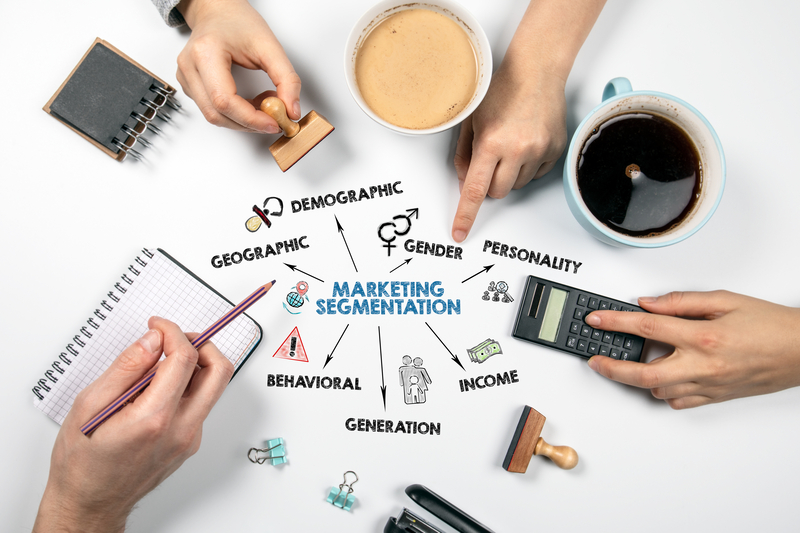
There are four primary customer segmentation examples that apply to nearly every business. Each uses different data and works best for different goals.
| Type | What It Uses | Best For | Example |
|---|---|---|---|
| Demographic | Age, income, job title, education, gender | Broad audience targeting, product positioning | A Denver fitness studio sends different class schedules to 25-34 year olds vs. 55+ members |
| Geographic | Location, region, climate, urban vs. rural | Local businesses, multi-location brands | A Colorado outdoor gear company runs different promotions for Front Range vs. Western Slope customers |
| Behavioral | Purchase history, website activity, email engagement | Retention, cart abandonment, upselling | An ecommerce brand sends different offers to first-time buyers vs. repeat customers |
| Psychographic | Values, interests, lifestyle, attitudes | Brand positioning, content marketing, premium products | A B2B consulting firm segments prospects who prioritize cost savings vs. those who prioritize speed |
Demographic Segmentation
Demographic segmentation is the most common starting point because the data is easy to collect. Age, income, job title, and household size are standard fields in most CRMs and signup forms.
The limitation is that demographics alone don't tell you much about behavior. Two 35-year-old professionals in the same zip code can have completely different buying patterns. Demographics give you a rough frame. You'll almost always need to layer in at least one other segmentation type to make it actionable.
Life stage marketing is a more refined version of demographic segmentation. Instead of grouping by age alone, it groups by life events: first-time homebuyers, new parents, recent retirees. These tend to predict purchasing behavior more accurately.
Geographic Segmentation
Geographic segmentation groups customers by where they are. For local and regional businesses, this is often the first variable that matters.
A restaurant with two locations might segment by neighborhood to send different promotions to each audience. A home services company might segment by zip code to target areas where they have capacity. An ecommerce brand might segment by climate zone to promote seasonal products at the right time.
If your business serves Denver and Colorado primarily, geographic segmentation also informs your Google Ads targeting and Google Business Profile strategy. Segmented audiences can shape which GBP posts you publish, which promotions you run by location, and how you target service areas.
Behavioral Segmentation
Behavioral segmentation groups customers by what they do, not who they are. Purchase frequency, average order value, email open rates, pages visited, and cart abandonment all fall into this category.
This is where most businesses get the highest return. Salesforce's State of the Connected Customer report found that 88% of customers say the experience a company provides matters as much as its products. Behavioral segmentation is how you shape that experience, by responding to what customers actually do instead of guessing based on who they are.
Sending a re-engagement email to customers who haven't purchased in 90 days is more effective than sending the same promotion to your entire list. Offering a loyalty reward to repeat buyers costs less than acquiring a new customer.
The data for behavioral segmentation typically lives in your email platform, ecommerce system, or Google Analytics 4. You don't need additional tools. You need to look at what's already being tracked.
Psychographic Segmentation
Psychographic segmentation groups customers by their values, interests, and motivations. This is harder to measure than demographics or behavior, but it produces stronger brand loyalty when done well.
You can gather psychographic data through customer surveys, social media interactions, review analysis, and sales conversations. The key question: why does this customer choose you over a competitor?
A B2B company might find that some prospects value speed above all else, while others care most about cost control. Those two groups need different messaging, different case studies, and different sales approaches, even if their demographics are identical.
03 - ProcessHow to Segment Your Customers in 5 Steps
Here's a practical process for building customer segmentation strategies that work with the resources you have right now.
Step 1: Audit the Data You Already Have
Before you buy anything or build anything, look at what you've got. Most businesses have more usable customer data than they realize.
Check these sources:
- CRM (HubSpot, Salesforce, even a spreadsheet with customer records)
- Email platform (Mailchimp, Klaviyo, ActiveCampaign: open rates, click rates, list tags)
- Google Analytics 4 (traffic sources, pages visited, engagement by audience)
- Ecommerce platform (purchase history, average order value, repeat rate)
- Sales records (deal size, sales cycle length, close rate by customer type)
Step 2: Pick One Primary Segmentation Variable
Don't try to segment by everything at once. Start with the variable that most directly connects to how you make money.
For most B2C businesses, that's behavioral data (purchase frequency or recency). For most B2B businesses, that's firmographic data (company size or industry). Pick one and build from there.
Step 3: Build 3-5 Segments
This is where most businesses overcomplicate things. You don't need 30 micro-segments. You need 3-5 clearly defined groups that you can actually act on.
For example:
- New customers (first purchase in the last 30 days)
- Active repeat buyers (2+ purchases in the last 6 months)
- Lapsed customers (no purchase in 90+ days)
- High-value customers (top 20% by lifetime spend)
- Prospects (signed up or inquired but never purchased)
We've worked with businesses across Colorado that had years of customer data sitting untouched in their CRM. The first thing we do is pull three simple segments (new customers, repeat buyers, and lapsed customers) and run targeted email campaigns to each. In most cases, the first lift comes from reactivation and repeat-buyer messaging, because those audiences already know you. That's usually enough to justify the effort before we get into more complex segmentation.
One caveat: if your total customer list is small, combine segments until each group has enough volume to test. A segment of 15 people won't give you reliable results. You need enough in each group to draw real conclusions.
Step 4: Test With a Single Campaign Per Segment
Send each segment a different message. Different subject line, different offer, different CTA. Keep the test simple so you can clearly attribute the results.
If your lapsed customer segment gets a "we miss you" email with a 15% discount and your repeat buyer segment gets an early access offer, you'll see within one campaign cycle which segment responds and which doesn't.
Step 5: Measure and Adjust
Every segment should be tied to a measurable outcome. Open rate, click-through rate, conversion rate, revenue per segment. If a segment doesn't perform, it's either poorly defined or not worth targeting separately.
Review your segments quarterly. Customer behavior changes. A segment that performed well six months ago might need to be split, merged, or retired.
This is also where improving website conversions connects to segmentation. If you're driving segmented traffic to your site but conversion rates stay flat, the problem might not be your segments. It might be your landing pages.
04 - B2B FocusHow Does Customer Segmentation Work for B2B?
B2B customer segmentation uses different variables than B2C, but the principles are the same: group by shared characteristics, tailor your approach to each group.
The main differences:
Firmographic segmentation is the B2B equivalent of demographics. Instead of age and income, you segment by company size, industry, annual revenue, and number of employees. A marketing agency might segment prospects into "companies with 10-50 employees and no in-house marketing team" vs. "companies with 200+ employees and an existing marketing department." Those two groups need completely different service proposals.
Technographic segmentation groups prospects by the tools and platforms they use. If you sell software that integrates with HubSpot, you'd segment prospects who already use HubSpot separately from those on Salesforce or those with no CRM at all. Each group has different switching costs and different objections. You can also layer in intent signals from your own data. If a prospect visits your pricing page, downloads a case study, and opens three emails in a week, that behavioral pattern tells you more about purchase readiness than their company size or industry ever will. GA4 and most CRMs can track these signals without additional tools.
Behavioral segmentation in B2B tracks actions like content downloads, webinar attendance, demo requests, and sales email engagement. These behaviors signal purchase intent more reliably than job titles or company size.
Needs-based segmentation clusters prospects by their primary pain point. Two companies the same size in the same industry might have opposite problems. One needs lead generation. The other has plenty of leads but can't close them. Same demographic profile, completely different messaging required.
The biggest B2B segmentation mistake is segmenting by industry alone and calling it done. Industry tells you context, but it doesn't tell you readiness or need. Layer behavioral signals on top of firmographics to get segments you can actually sell to.
05 - ToolsTools That Make Segmentation Easier
You don't need expensive technology to segment your customers. Match the tool to your scale.
- Fewer than 500 customers, simple segments
- Spreadsheet + email tags
- Running paid search or retargeting
- GA4 audience segments
- Long, relationship-driven sales cycle
- CRM stages + triggers
- Data in 5+ systems with ops support
- Customer data platform
When a spreadsheet is enough: If you have fewer than 500 customers and simple segmentation needs (new vs. repeat vs. lapsed), a filtered spreadsheet or Google Sheet works. Use the FILTER or Pivot Table function in Google Sheets to isolate your top 20% of customers by revenue. That's your VIP segment. Sort the rest by last purchase date, tag each group, and export your lists to your email platform. This isn't glamorous. It works.
When GA4 alone is enough: Google Analytics 4 has built-in audience segments. You can create audiences based on behavior (visited pricing page, spent 3+ minutes on site, came from a specific campaign) and push them directly to Google Ads for retargeting. If your primary goal is behavioral segmentation for ad targeting, GA4 covers it at no cost.
CRM-based segmentation: HubSpot (free tier and Starter), Salesforce Essentials, and Zoho CRM all support contact segmentation with list filters and tags. If you're already paying for a CRM, use its segmentation features before buying anything new.
Email platform segmentation: Mailchimp, Klaviyo, and ActiveCampaign all let you build segments from subscriber data, purchase behavior, and engagement metrics. For most small businesses running email campaigns, the email platform IS the segmentation tool.
A note on data quality in 2026: The most useful segmentation data isn't always tracked automatically. It's told to you directly. Zero-party data, information customers share willingly through surveys, preference centers, quizzes, and onboarding forms, is often more accurate than behavioral tracking and keeps you on the right side of privacy regulations. Colorado updated its privacy laws in 2025, and businesses nationwide are dealing with similar compliance requirements. Building segments from data customers give you voluntarily is both more reliable and less risky than relying solely on cookies and tracking pixels.
When you actually need a CDP: Customer data platforms like Segment or Tealium make sense when you have data spread across 5+ systems and need a unified view. For most businesses under $10M in revenue, a CRM and an email platform handle 80% of segmentation needs. Don't buy a CDP because a vendor told you that you need one. Buy it when your existing tools genuinely can't keep up.
06 - Common MistakesCommon Customer Segmentation Mistakes (and How to Avoid Them)
Segmentation fails more often from bad execution than bad strategy. Here are the patterns we see most frequently.
Over-segmenting with small datasets. If your segment has 12 people in it, it's not a segment. It's a guest list. You need enough volume in each group to draw meaningful conclusions and justify the effort of creating separate campaigns. For most small businesses, 3-5 segments is the right starting range.
Buying tools before proving the concept. Don't invest in a $500/month platform until you've proven segmentation works with the free tools you already have. Run a segmented email campaign using your existing email platform. If the results justify it, upgrade. If they don't, the problem isn't your tools.
Building segments and never acting on them. Segmentation is only useful if it changes what you do. If you create five segments and then send the same email to all of them, you've just spent time organizing data for no reason. Every segment needs a different message, offer, or experience.
Ignoring behavioral data. Demographics are easy to collect. Behavior is harder to track but far more predictive. A 40-year-old who visits your pricing page three times is a hotter lead than a 30-year-old who matches your ideal customer profile but hasn't opened an email in six months. Prioritize what people do over who they are.
Not tying segments to measurable KPIs. If you can't measure how a segment performs, you can't improve it. Every segment should connect to at least one KPI: conversion rate, customer lifetime value, average order value, or retention rate. A conversion rate audit can help you identify which segments are converting and which are leaking revenue.
07 - FAQFAQs About Customer Segmentation Strategies
Start with behavioral segmentation using the data in your CRM or email platform. Group customers by purchase recency and frequency: new buyers, repeat buyers, and lapsed customers. This gives you three actionable segments you can target immediately without any new tools. We use this approach regularly with Denver and Colorado businesses and it consistently produces better results than broad, unsegmented campaigns.
Most businesses get the best results with 3-5 segments. Fewer than three and you're not really segmenting. More than five and you risk spreading your resources too thin, especially if your total customer base is under a few thousand. You can always add segments later once the initial ones are proven.
Market segmentation looks at an entire market to identify which groups exist and where opportunities are. Customer segmentation focuses specifically on people who already interact with your business (buyers, subscribers, leads). Customer segmentation is more actionable because you already have data on these people.
B2B segmentation typically starts with firmographic data (company size, industry, and revenue), then layers in behavioral signals like content engagement, demo requests, and sales cycle length. The goal is to separate high-intent prospects from early-stage researchers so your sales team spends time on the right accounts.
For most businesses, you already have what you need. Your CRM, email platform, and Google Analytics 4 can handle the majority of segmentation tasks. A filtered spreadsheet works fine for businesses with fewer than 500 customers. Customer data platforms are worth considering only when data is spread across many systems and manual integration becomes a bottleneck.
Review your segments quarterly. Customer behavior changes, seasonal patterns shift purchasing, and new customers change the composition of your groups. A segment that worked in Q1 might need adjusting by Q3. Set a calendar reminder and review segment performance alongside your other marketing KPIs.
Yes. If you use an email platform like Mailchimp or Klaviyo, you can segment subscribers by engagement, purchase history, and tags. Google Analytics 4 lets you build audience segments from website behavior data. Even a well-organized spreadsheet works at small scale. A CRM makes segmentation easier as you grow, but it's not required to start.
Get a Segmentation Audit for Your Business
Customer segmentation doesn't require a massive budget or a team of data analysts. It requires a clear look at the customer data you already have and a willingness to act on what it tells you.
We identify your top 3-5 customer segments, recommend the right variables and tools for your business, and deliver a campaign plan for each segment. Available for businesses in Denver, across Colorado, and nationwide.
Request a Segmentation AuditFounder of Creative Options Marketing, a Denver-based marketing agency serving businesses locally and nationwide since 2009. He has led customer segmentation and audience strategy for B2C and B2B brands across healthcare, ecommerce, professional services, and local markets. David specializes in SEO and data-driven strategy that connects brands with the right audiences. Connect on LinkedIn